
Cost & Pricing· 7 min read· Updated
French Drain Cost Breakdown: Solving Blackland Clay Flooding
What a French drain really costs in Central Texas clay, including per-foot pricing, excavation challenges, pipe selection, and discharge options.
By the Oakwood Landscaping team · Reviewed by Emmanuel Heredia Sanchez, Owner & TCEQ Licensed Irrigator
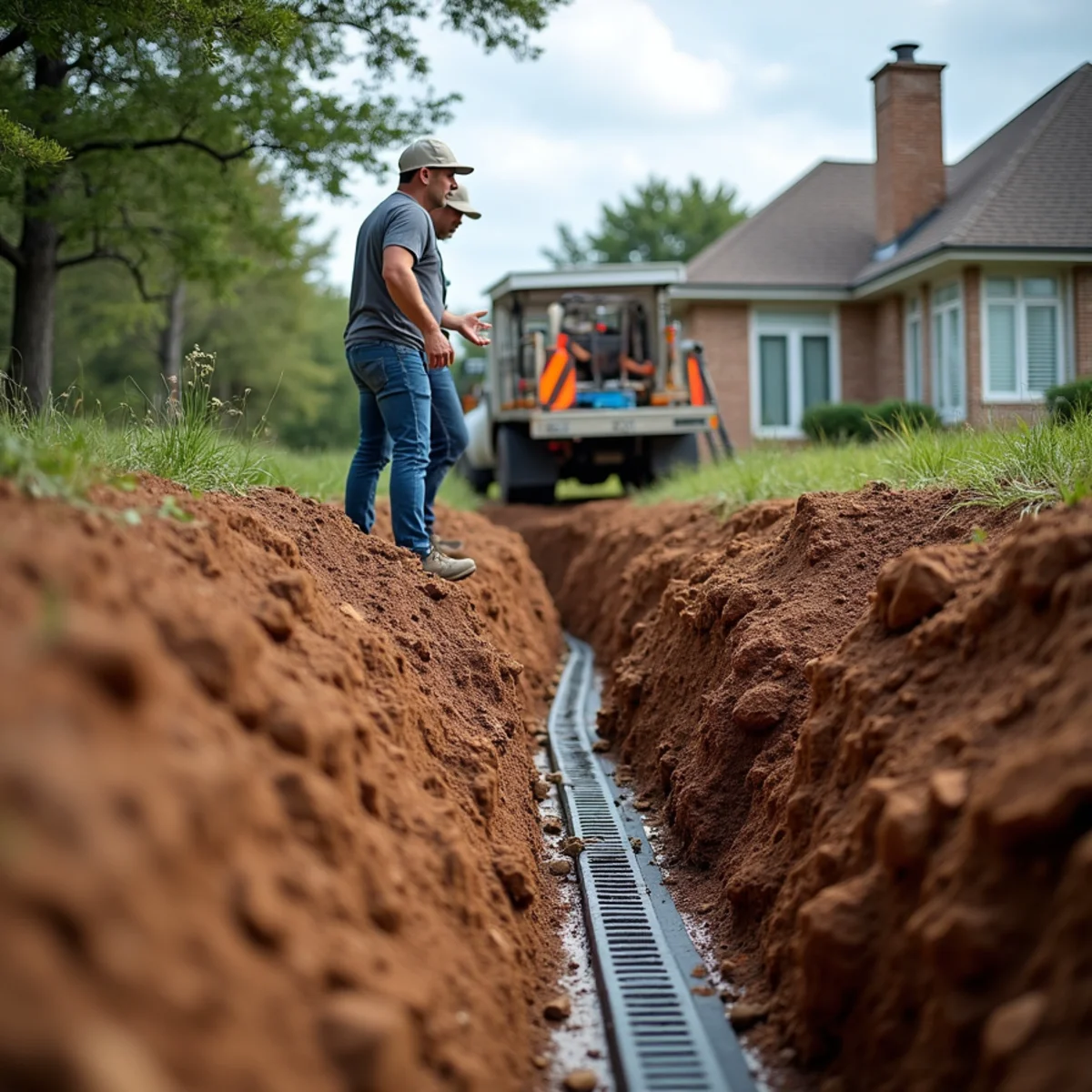
If water pools against your house every time it rains hard, or a low spot in the yard turns to standing mud that lingers for days, you are living with one of the most common and most damaging problems in Central Texas. Blackland clay does not drain well, and water that has nowhere to go ends up sitting where it can do the most harm: against your foundation.
A French drain is the standard engineered fix. It is a gravel-filled trench with a perforated pipe that collects subsurface water and carries it away to a safe discharge point. Done right, it is one of the best investments you can make in protecting your home. Done poorly, it clogs and fails within a few years.
This breakdown covers what a French drain actually costs in the Austin metro's expansive clay, why excavation here is harder than in many regions, which pipe holds up long term, and what catch basins and pumps add. Understanding the parts will help you tell a real drainage solution from a cheap trench.
The Real Cost of Foundation Shifting Caused by Saturated Clay Soil
Before talking about the price of a drain, it is worth understanding the price of not having one. Blackland clay is an expansive montmorillonite vertisol, which means it swells dramatically when it absorbs water and shrinks when it dries out. That cycle exerts enormous force on anything buried in or resting on it, including your slab.
When water repeatedly saturates the soil on one side of a foundation and not the other, the ground heaves unevenly. Over time that differential movement cracks slabs, sticks doors, splits drywall, and separates brick. Foundation repair in this area routinely runs into the many thousands of dollars, and it treats the symptom rather than the cause.
A French drain attacks the cause by controlling where water goes and keeping moisture around the foundation more even. Against the potential cost of foundation repair, a properly engineered drain is a comparatively modest and preventative expense. That is the frame worth keeping in mind as you weigh the numbers below.
Average Linear-Foot Costs for Residential French Drains
Like fencing, French drains are priced primarily by the linear foot, plus the fixed costs of connections and discharge. Researched local ranges put a typical residential French drain around 3,100 dollars for a common installation, though your project can land above or below that depending on length, depth, and access. Always treat that as a typical regional range rather than a fixed quote; your estimate depends on your specific site.
The per-foot number rises with depth, because deeper trenches move more soil and rock. It rises with length, obviously, but longer runs sometimes lower the per-foot cost as mobilization is spread out. It rises again if the crew has to work around trees, existing irrigation, hardscape, or utilities, all of which slow the dig.
Access is an underrated cost factor. A backyard reachable only through a narrow gate may have to be trenched by hand or with small equipment, which is far slower than a machine working an open lot. A good estimate reflects how hard your particular yard is to reach and dig, not just how many feet of pipe it needs.
- Trench length in linear feet.
- Trench depth, which drives excavation volume.
- Soil versus rock along the run.
- Yard access for machinery versus hand digging.
- Obstacles: trees, utilities, irrigation, and hardscape.
Excavation Challenges in Expansive Austin Metro Vertisol Clay
Digging in Blackland clay is its own challenge. When it is dry, the clay is hard as concrete and cracks into deep fissures. When it is wet, it turns sticky and heavy, clinging to buckets and boots and making every shovelful harder to move. Neither condition is easy, and the ideal window between them is narrow.
In parts of the metro closer to the Hill Country, the clay gives way to limestone, and a drain trench may hit rock that has to be cut. This is why excavation is often the single largest labor component of a French drain here, and why quotes that seem too cheap usually mean too shallow a trench or too little gravel.
Proper excavation also means grading the trench to a consistent slope so water actually flows to the outlet. A drain that is dug flat, or that dips in the middle, will hold water and silt up. The care taken during excavation is invisible once the trench is backfilled, which is exactly why it is worth hiring someone who does it right the first time.
Pipe Selection: Why Perforated Smooth-Wall PVC Beats Corrugated Slinky
The pipe is where cut-rate drainage jobs fail. The cheap option is flexible corrugated pipe, the black accordion-style tubing often called slinky pipe. It is fast to install and inexpensive, but its ridged interior catches sediment and roots, its thin wall crushes under soil load, and it clogs and sags over time. In our clay, it is a short-term fix that becomes a buried problem.
The right choice for a lasting drain is rigid perforated smooth-wall PVC. The smooth interior lets water and fine sediment flow through instead of collecting, the rigid wall resists the crushing pressure of expansive clay, and it holds its grade so the slope you engineered stays put. It costs more in material and takes more care to install, and it is worth every bit of it.
Around the pipe, the details still matter: clean washed gravel, a proper filter fabric to keep clay fines from migrating in and clogging the system, and correct orientation of the perforations. When someone quotes a French drain, ask what pipe they use. The answer tells you a great deal about whether the drain will still be working in ten years.
Catch Basins, Sump Pumps & Gravity Discharge Outfall Costs
A French drain has to send its water somewhere, and how it discharges is a real part of the cost. The simplest and most reliable method is gravity discharge to a lower outfall, such as a street, alley, or downhill area of the property. If your lot slopes cooperatively, this is the cleanest solution and the least expensive to maintain because there is nothing mechanical to fail.
When the yard is flat or the low point is the house itself, gravity is not enough and a sump pump is added to lift water up and out. That means a sump basin, a pump, a check valve, and a discharge line, plus electrical, all of which raise the cost. Pumps are effective but they are a component that needs power and occasional service, so they are used where the grade leaves no choice.
Catch basins are surface inlets that capture pooling water and tie it into the drain system, useful for a specific low spot or the base of a downspout. Many properties end up with a combination: a French drain for subsurface water, catch basins for surface pooling, and either gravity or a pump to move it all to a legal discharge point.
- Gravity outfall: cheapest and most reliable when grade allows.
- Sump pump system: needed on flat lots, adds mechanical cost.
- Catch basins: capture surface pooling and downspout water.
- Discharge must go to a legal, safe point off your foundation.
Contact Our Drainage Contractors for an Engineered Site Survey
No two drainage problems are alike, and a French drain that solves your neighbor's flooding could be the wrong design for yours. That is why we start with a site survey: we look at where water comes from, how your lot grades, where it can legally discharge, and what soil and rock we will be digging through before we design anything.
Oakwood Landscaping is BBB Accredited, licensed, and insured, and we build drainage systems the right way, with rigid perforated PVC, proper gravel and filter fabric, correct slope, and a discharge plan that actually moves water off your foundation. We will also call Texas811 to locate utilities before any excavation, because that is both the law and simple common sense.
If water is threatening your foundation or ruining your yard, call Oakwood Landscaping at (323) 606-0255 for a free engineered site survey and a clear, itemized estimate. We will show you exactly where your water is going and how to send it somewhere safer.
Get Expert Help
Oakwood Landscaping can handle this for you across Round Rock and Central Texas. Explore the services in this guide: