Emergency· 6 min read· Updated
Severe Thunderstorm Fence Blowdown: Emergency Shoring & Safety
What to do when a Texas thunderstorm blows your fence down, including immediate safety steps, temporary T-post shoring, insurance guidance, and lasting repair.
By the Oakwood Landscaping team · Reviewed by Emmanuel Heredia Sanchez, Owner & TCEQ Licensed Irrigator
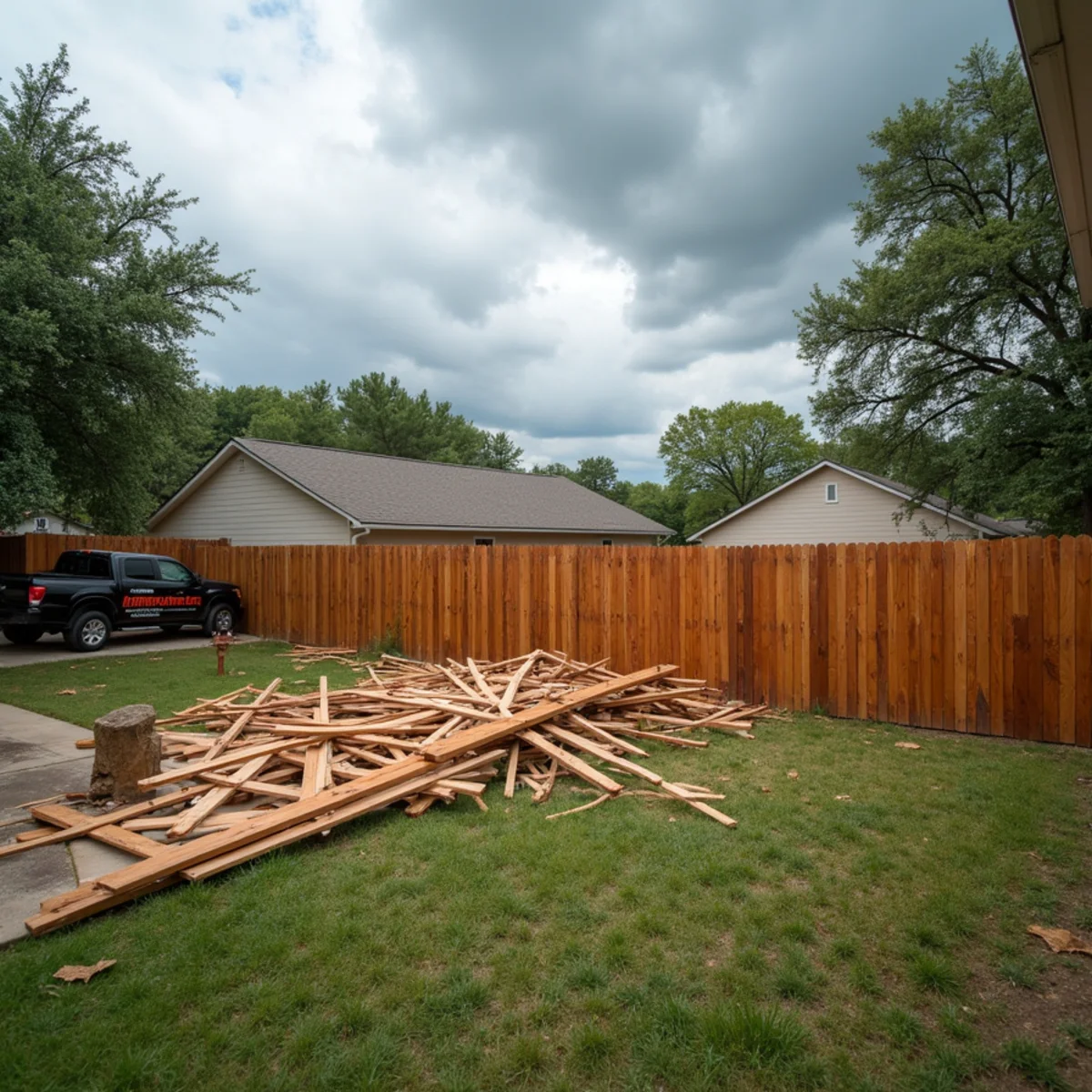
A line of severe thunderstorms can flatten a fence in seconds. Central Texas storms routinely pack straight-line wind gusts of 60 to 70 miles per hour, and a privacy fence is essentially a solid wall that catches every bit of that force. When posts give way, whole sections come down at once, often taking the neighbor's side with them.
The moments after a blowdown are about safety and containment, not construction. A leaning or dangling fence panel is heavy and unstable, downed sections can hide hazards, and a gap in the fence line is an immediate problem if you have pets or a pool. Getting things stabilized comes first.
This guide covers the sequence that matters: securing people and pets, temporarily shoring what is standing, understanding why the fence failed where it did, working with your insurance, and getting a permanent rebuild that survives the next storm. When the wind has passed, this is your plan.
The Power of 70 MPH Straight-Line Texas Thunderstorm Gusts
It does not take a tornado to destroy a fence. Straight-line winds, the powerful downburst gusts that spread out ahead of a thunderstorm, regularly reach 60 to 70 miles per hour here and can exceed it. A six-foot privacy fence presents a large, solid surface to that wind, and the force adds up across every panel.
Wind load is the technical name for it, and it is concentrated at the posts and at the connections between panels and rails. When the wind hits, the weakest link fails first, whether that is a rotted post, an undersized post, or a joint that was never fastened well. That is why storm damage so often reveals which fences were built to last and which were not.
Understanding the force involved reframes the repair. The goal is not simply to stand the fence back up. It is to rebuild it so the next 70 mile-per-hour gust, which will come, does not put it right back on the ground. That distinction guides everything from post choice to spacing.
Immediate Safety Steps: Securing Pets and Bracing Dangling Panels
Your first priority is living things. A gap in the fence means pets can get out and hazards can get in, so contain animals indoors or on a leash until the fence line is closed off, and keep children away from the downed sections. A partially collapsed fence can shift or fall further without warning.
Before touching anything, scan for hazards. Look for any power lines contacting the fence or downed nearby, and if you see any, stay well clear and call the utility, because metal fence components can carry current. Watch for exposed nails and screws, splintered wood, and unstable panels that could drop when disturbed.
For panels that are leaning but not fully down, a temporary brace can keep them from falling on someone or something. A couple of scrap boards or posts wedged against a leaning section, angled into the ground on the safe side, will hold it steady until a proper repair. Do not try to muscle a heavy section upright alone.
- Contain pets and keep children clear of downed sections.
- Check for downed or contacting power lines and stay away.
- Watch for exposed nails, screws, and splintered wood.
- Brace leaning panels so they cannot fall further.
- Close off gaps in the fence line as soon as it is safe.
Temporary T-Post Shoring While Waiting for Permanent Construction
Once things are safe, temporary shoring can get a leaning fence back to roughly vertical and hold the line until a permanent rebuild. The simplest reliable method uses steel T-posts, the inexpensive green fence posts sold at any farm or hardware store, driven into the ground next to failed posts.
Drive a T-post a couple of feet into the ground right beside a leaning or broken post, then fasten the fence to the T-post with wire, screws, or heavy zip ties to hold the section upright. Spacing several T-posts along a damaged run distributes the load and keeps the fence standing through follow-up weather while you arrange the real repair.
This is a stopgap, not a fix. T-post shoring closes the gap, protects your pets, and stops further damage, but it is not a substitute for properly set posts. Think of it as first aid for the fence: it stabilizes the patient so the permanent work can be done right rather than rushed.
Why Rotting Pine Posts Snap at the Ground Level First
When you inspect a blown-down fence, look at where the posts broke. Overwhelmingly, wood posts snap right at ground level, and the reason is rot. That zone, where the post meets the soil, stays damp and is attacked by moisture from both the ground and the surface, so the wood weakens there long before the parts you can see above grade.
Our soil makes it worse. Blackland clay holds moisture against the buried post and its shrink-swell movement loosens the post over years, so by the time a big storm arrives, the post is already compromised at exactly the point where the wind load is highest. It does not so much break in the storm as finally give way.
This is the strongest argument for galvanized steel posts, which do not rot and do not lose strength at ground level. When we rebuild a storm-damaged fence, moving to steel posts is usually the single most important upgrade, because it eliminates the failure point that put the fence on the ground in the first place.
Working with Homeowners Insurance on Storm Damage Claims
Many homeowners policies cover fence damage from wind and storms, though coverage, deductibles, and depreciation vary, so read your policy or call your agent before assuming anything. Storm fence damage is common enough here that insurers deal with it regularly, and a legitimate wind blowdown is often a covered event.
Document everything before you clean up. Take clear photos and video of the downed fence from several angles, capture the broken posts and any surrounding damage, and note the date of the storm. If you do temporary shoring for safety, photograph the before state first, since insurers want to see the original damage.
Keep receipts for any emergency work and get a written, itemized estimate for the permanent repair. A reputable contractor can provide documentation that supports your claim and describe the damage and scope in the terms an adjuster expects. We are happy to work alongside your claim process and provide the paperwork you need.
Call Oakwood Landscaping for Fast Emergency Fence Restoration
After a storm, response time matters, both to secure your property and to get on the schedule before the whole neighborhood calls. We handle the full sequence: stabilizing what is standing, safely removing what is down, and rebuilding the fence to stand up to the next round of Texas wind.
Oakwood Landscaping is BBB Accredited, licensed, and insured, and we rebuild storm-damaged fences on galvanized steel posts with proper depth and spacing so the failure that caused the blowdown does not repeat. We will assess the whole fence line, not just the section that fell, because storm-weakened posts nearby are often the next to go.
If a thunderstorm has taken down your fence, secure the area using the steps above and then call Oakwood Landscaping at (323) 606-0255 for fast emergency fence restoration. We will get your property closed off quickly and rebuild it right.
Get Expert Help
Oakwood Landscaping can handle this for you across Round Rock and Central Texas. Explore the services in this guide: