Emergency· 7 min read· Updated
Flash Flood Yard Damage: Saving Your Foundation in Central Texas
How Central Texas flash floods threaten your foundation and what to do about it, from emergency storm steps to permanent dry creek beds and French drains.
By the Oakwood Landscaping team · Reviewed by Emmanuel Heredia Sanchez, Owner & TCEQ Licensed Irrigator
Central Texas does not get gentle rain. It gets deluges, the kind that drop several inches in an hour and turn a dry yard into a lake before the storm even passes. For homeowners here, the danger is not just the water in the yard. It is what that water does to the ground around the house and, ultimately, to the foundation.
This region sits in what meteorologists call Flash Flood Alley, one of the most flood-prone areas in the country. The combination of intense downpours, tight clay soils that cannot absorb water fast enough, and terrain that funnels runoff means water arrives faster than the ground can handle it, again and again.
This guide covers both halves of the problem: what to do in the moment when a storm is threatening your home, and the permanent, engineered drainage that keeps the next flood from becoming an emergency at all. If storm water regularly reaches your foundation, this is the plan.
Why Central Texas Is Known as 'Flash Flood Alley'
The Balcones Escarpment runs through the middle of the region, where the flat coastal plains meet the rugged Hill Country. When moist air from the Gulf is lifted over that terrain, it wrings out enormous amounts of rain in a short time. The result is some of the most intense rainfall rates in North America, concentrated over a landscape that sheds water quickly.
The soils make it worse. Blackland clay absorbs water slowly, and shallow Hill Country limestone barely absorbs it at all, so most of a heavy rain becomes immediate runoff rather than soaking in. That runoff collects in creeks, low areas, and unfortunately, poorly graded yards, rising fast and falling just as quickly once the rain stops.
This is not a rare event you can ignore. The wet months of May, June, and October reliably deliver storms capable of overwhelming drainage, and any given year can bring a downpour that tests every low spot on your property. Planning for it is simply part of owning a home here.
How 4 Inches of Rain in 1 Hour Overwhelms Blackland Prairie Soils
Blackland prairie soil evolved under grassland, where dense root systems and organic matter helped moderate water. A modern yard, compacted and often stripped of that structure, absorbs far less. When four or more inches of rain fall in a single hour, which happens here, the ground simply cannot take it in fast enough, and the excess has to go somewhere on the surface.
That surface water follows the grade of your lot. If your yard slopes toward the house, or if a low spot sits near the foundation, the water pools exactly where you least want it. Even a yard that drains acceptably in a normal rain can fail catastrophically under a flash-flood rate, because the volume overwhelms whatever path the water normally takes.
The takeaway is that infiltration alone will never solve Central Texas flooding. You cannot make this clay soak up a four-inch-per-hour storm. The only reliable answer is to give the water a designed path to travel away from the house faster than it can pool, which is what proper drainage does.
Hydrostatic Pressure Pushing Water Through Foundation Weep Holes
When storm water saturates the soil against your foundation, it creates hydrostatic pressure, the force of standing water pressing against the slab and any below-grade masonry. That pressure does not just sit there. It pushes water into weep holes, seams, and any small opening, and over time it works against the structure itself.
On expansive clay, the problem compounds. The saturated soil swells and heaves against the foundation, and when it dries it shrinks and pulls away, and this repeated push and pull is what cracks slabs and separates brick. A single flood is bad; a yard that floods against the foundation every wet season is a slow-motion foundation problem in the making.
This is why yard drainage is really foundation protection. Keeping storm water from ponding against the house relieves the hydrostatic pressure and reduces the extreme wet-dry swings in the soil right where they matter most. The grass and beds are the visible beneficiaries; the slab is the important one.
Emergency Sandbagging, Sump Pumping and Surface Swale Clearing
When a storm is bearing down and water is heading for the house, a few actions genuinely help. Sandbags or even temporary barriers placed to redirect flow away from doorways and low foundation points can buy critical protection during the worst of a downpour. Position them to steer water around the house rather than trying to dam it completely.
If you have a sump pump or can deploy a portable utility pump, use it to move standing water from the lowest points toward a discharge away from the foundation. Keep extension cords and connections clear of the water for safety, and never wade into moving or deep water to reach equipment.
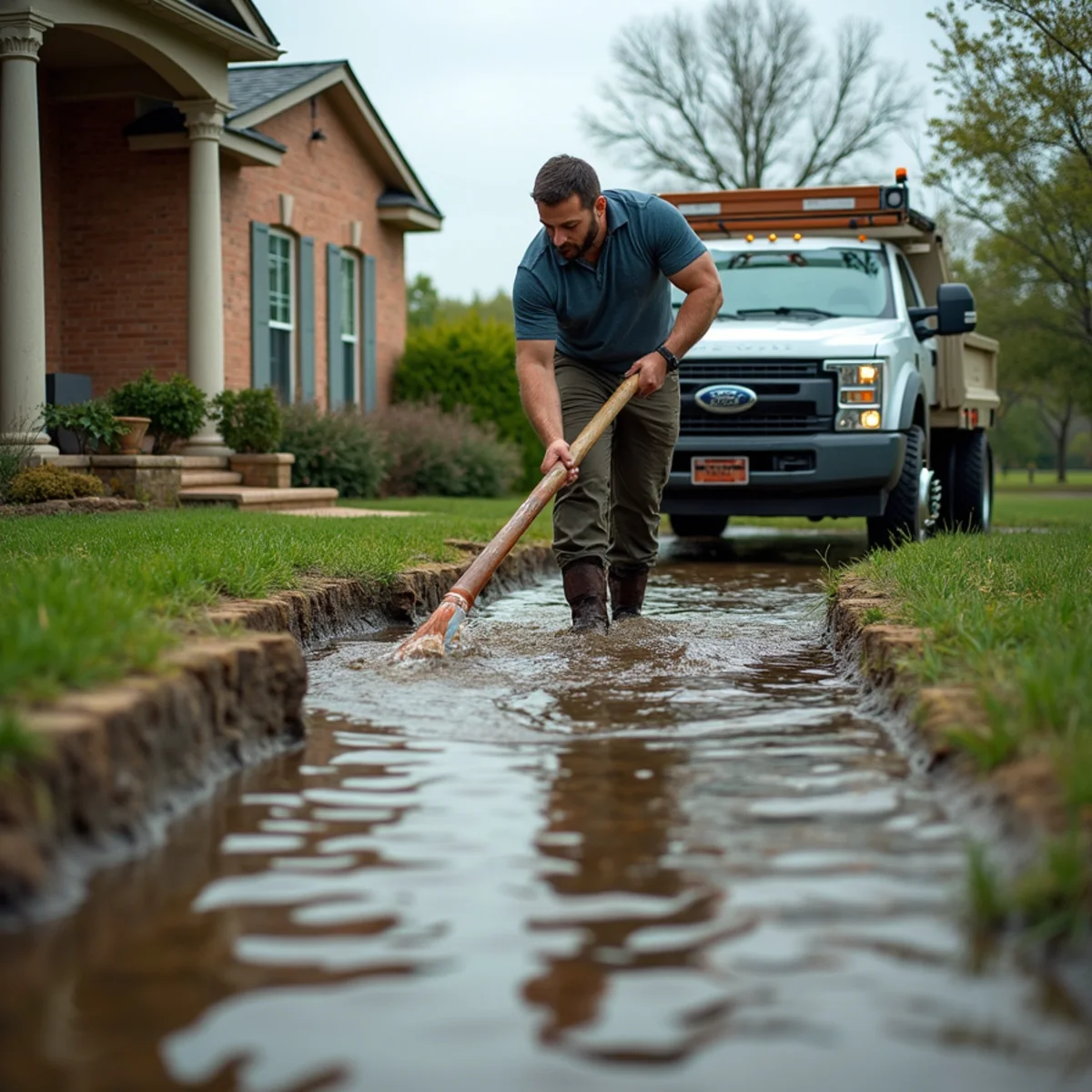
Just as important is clearing the paths water already wants to take. Rake leaves and debris out of surface swales, unclog downspout outlets and any catch basin grates, and make sure gutters are draining away from the house rather than dumping at the foundation. These small clearings can be the difference between water flowing past and water backing up.
- Redirect flow from doors and low points with sandbags or barriers.
- Pump standing water to a discharge away from the foundation.
- Clear leaves and debris from swales and catch basin grates.
- Free downspout outlets so gutters drain away from the house.
- Stay clear of moving or deep water and live electrical.
Permanent Engineered Defenses: Dry Creek Beds & Deep French Drains
Emergency measures buy time, but the real solution is engineered drainage that handles the storm before it becomes a crisis. A dry creek bed is a graded, rock-lined channel that gives surface runoff a defined, attractive path across the yard and away from the house. It handles high-volume flow, looks like a landscape feature rather than a ditch, and requires little maintenance.
Beneath the surface, a deep French drain collects subsurface and pooling water and pipes it to a safe discharge, keeping the soil around the foundation from staying saturated. In many Central Texas yards the best defense combines the two: a dry creek bed to move the big surface flows and a French drain to handle what soaks in, working together to keep water off the slab.
The key word is engineered. These systems have to be sized for our flash-flood rainfall rates, sloped correctly, and discharged to a legal, lower point. A generic drain built for a milder climate will be overwhelmed here. Designing for four inches an hour, not for average rain, is what separates a system that works from one that fails at the worst moment.
Schedule an Urgent Post-Storm Drainage Assessment
The best time to see exactly how water moves across your property is during or right after a heavy rain, when the pooling, the flow paths, and the trouble spots are all visible. If a recent storm sent water toward your foundation, that is the moment to get a professional assessment while the evidence is fresh.
Oakwood Landscaping is BBB Accredited, licensed, and insured, and we design drainage for the way Central Texas actually rains. We assess your grade, find where water enters and collects, and lay out a combination of dry creek beds, French drains, catch basins, and regrading sized for flash-flood conditions and discharged legally away from your home. We locate utilities through Texas811 before any digging.
Do not wait for the next downpour to test your luck. Call Oakwood Landscaping at (323) 606-0255 for an urgent post-storm drainage assessment and a permanent plan to keep flood water away from your foundation. Protecting the slab is far cheaper than repairing it.
Get Expert Help
Oakwood Landscaping can handle this for you across Round Rock and Central Texas. Explore the services in this guide: